
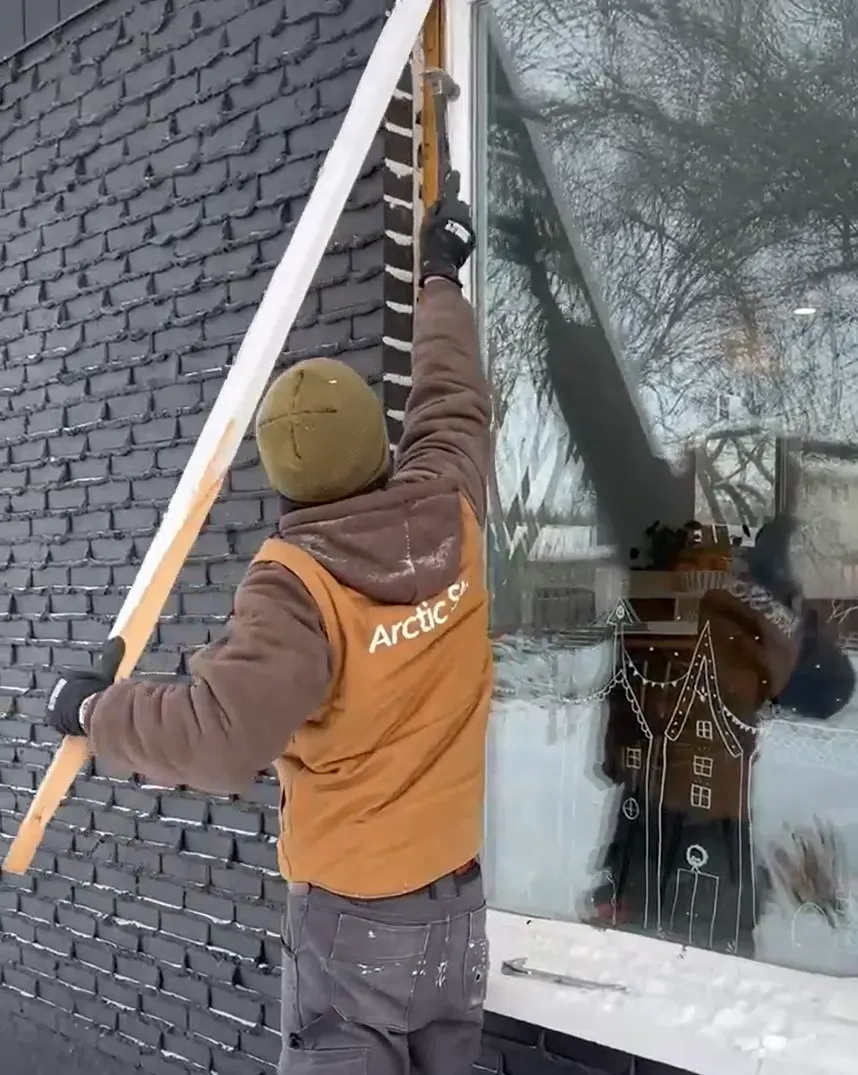
Yes. Winter window replacement in Winnipeg is routine, and we install all winter. The house is never open all at once: one window comes out, the new one goes in and is insulated and sealed, and only then does the next one come out. Here’s how a cold-weather install works, how much heat you really lose, what the cold changes about foam and sealant, which days are better rescheduled, and how to get your house ready.
The short answer
- Yes, it can be done. We replace windows and doors all year. In winter we work one opening at a time, with the room closed off.
- Each opening is open briefly. A standard window takes about 35 to 40 minutes, and the hole in the wall is uncovered for only part of that.
- You lose one room’s warm air at a time, not the whole house’s. The furnace runs a little longer that day.
- Cold changes the materials, not the method. Foam and sealant have minimum application temperatures, so winter work needs products rated for the day.
- A few days each winter are wrong for it: extreme cold with wind, blowing snow, freezing rain.
- The rebate works the same in January as in July. You apply within 90 days of the install and payment in full.
If you’re still deciding which month to buy or book, see our month-by-month guide to the best time to replace windows in Winnipeg.
How a winter window replacement works
The method is the one a careful installer uses in July. What changes in winter is the order: nothing is opened until everything needed to close it is ready.
- Everything is staged first. The new window, the tools, the foam and the sealant are at the opening before the old window is touched.
- The room is closed off. We shut the door to the room we’re working in, so the cold stays there and the rest of the house keeps its heat.
- The old window comes out. This is the only stage when the opening is uncovered. If we find rotten wood under the window, we replace it at no charge.
- The new window goes in. It’s set in the opening, levelled and fastened. From here on, the room is closed to the weather again.
- It’s insulated and sealed. The gap between the new frame and the wall is filled with low-expansion foam made for windows and doors, and the outside joint gets a cold-weather sealant.
- Finishing, then the next opening. Every window is insulated and sealed the same day, before the next one comes out. Nothing is left open overnight.
A standard window takes about 35 to 40 minutes, a basement window 1 to 2 hours depending on trim and finish, and a bay or bow window about 2 hours. Most whole-house jobs take 1 to 3 days. See how long window replacement takes for the timeline from quote to install day.
How long each opening is open, and the heat you lose
You lose less heat than most people expect, for three reasons.
- The opening is uncovered for only part of the job. Of the 35 to 40 minutes a standard window takes, the hole is open from the moment the old window comes out until the new one is set in place. Insulating, sealing and trim happen with the new window already in the wall.
- Only one room is exposed. With the door shut, the rest of the house stays close to its normal temperature.
- Air holds very little heat. What escapes is mostly the warm air in that one room.
Here is the arithmetic. A bedroom 3 m by 3.5 m with a 2.4 m ceiling holds about 25 cubic metres of air, which weighs about 30 kg. Warming that air from −25 °C back up to 21 °C takes about 0.4 kWh, going by the density and specific heat of air. A 1,500-watt plug-in heater gives off that much heat in about 15 minutes.
The real loss is higher. While the opening is uncovered, the air in the room changes more than once, and the walls, floor and furniture give up heat that the furnace then puts back. We don’t have a measured figure for a whole job and we won’t invent one. But the reasoning holds: one room, a closed door and a short gap add up to a furnace that runs a little longer, not a cold house.
What you will notice: the room being worked on gets cold while its window is out, and the entry cools as the crew goes in and out. A big front window in an open-plan living room can’t be shut behind a door, so more of the house feels that one. Ask us at your estimate how we’d handle it. Leave the thermostat at its normal setting; turning it down only makes the room slower to recover.
What the cold changes: foam and sealant
The parts of the job that react to cold are the ones that have to cure: the foam around the frame and the sealant outside. Each product has an application range printed on its technical data sheet. These four examples from manufacturers’ data sheets show the spread. They aren’t a list of what goes on every job.
| Product | What its data sheet says | What that means in a Winnipeg winter |
|---|---|---|
| Standard window and door foam | LePage QUAD Foam: apply when the surfaces and work area are between −10 °C and 35 °C. Keep the can between 5 °C and 30 °C, ideally at room temperature for 12 hours before use. | Fine on a mild winter day, not in a cold snap. Cans have to stay warm until they’re used. |
| Winter-grade gun foam | Tytan Professional Low Expansion 65 Winter: air and surface from −20 °C to 30 °C. Ready to cut in about half an hour at 23 °C, but 20 hours at −10 °C and 48 hours at −20 °C. | Covers most winter working days, but it cures far more slowly, so it’s left alone before it’s trimmed. |
| Silicone sealant | Mulco Universal Silicone: application temperature −37 °C to 65 °C, on a clean, dry surface. | Can go on in almost any weather a crew would work in, once frost and snow are cleared from the joint. |
| Acrylic latex caulk | DAP Alex Plus: apply between 40 °F and 100 °F (about 4 °C to 38 °C), and not when freezing temperatures are forecast within 24 hours. | An indoor product in winter. Fine on interior trim in a heated room, wrong for the outside joint. |
- Low-expansion foam only. Natural Resources Canada’s Keeping the Heat In says to “use only low expansion type around window and doorframes or risk bowing.” A bowed frame won’t close or lock properly.
- Dry, clean surfaces. Sealant sticks to the wall, not to frost. Snow and ice have to be brushed out of the opening first.
- Curing takes longer. Outside in January, foam and sealant keep curing long after the crew has left, so don’t press on a fresh bead of caulking or pick at foam.
Exterior caulking is the step most affected by cold, which makes it the one most likely to need a touch-up. Look the outside joints over when the snow is gone, and call us if one has opened.
The days we’d rather reschedule
There is no single cut-off temperature, and we won’t make one up. Wind, snow and the kind of job matter as much as the thermometer. These are the conditions that should make any installer think twice:
- Extreme cold. On the coldest mornings of the year, the air and the wall can be colder than even a winter-grade foam’s printed limit (−20 °C in the example above).
- Strong wind on the wall being worked on. It drives cold air and snow into the open room and makes ladder work on a second storey unsafe.
- Blowing or heavy snow. Snow in the opening means wet surfaces, and sealant needs a dry one.
- Freezing rain. Ice on ladders, steps and sills is a safety problem before it’s a quality problem.
Some jobs are more sensitive than others. A ground-floor bedroom window on the sheltered side of the house is the easy case. A bay or bow window, a large picture window in an open room, or second-storey windows on a windy day are the ones to plan around the forecast. If the weather turns, moving the date by a few days beats a rushed seal.
Doors are replaced in winter too. A standard entry door takes about 3 hours and a double door about 4, and the opening leads straight into the house, not into a closed room, so a milder day is worth waiting for. See what replacing an entry door costs.
Pros and cons of replacing windows in winter
The upside
- You feel the difference the same night. The draft at the old window is gone by bedtime, and the new glass is warmer to sit beside.
- The problems are easy to find. In January, drafts and frost on the glass show exactly which windows are worst. At a summer estimate you’d be describing them from memory.
- You don’t wait for spring. You can order now; ask us for the current lead time, or see our FAQ.
The downside
- Comfort during the visit. One room at a time is cold, and the entry door opens often.
- Weather can move your date.
- Exterior caulking may need a touch-up once it warms up.
- Some outdoor work waits. If the job needs exterior painting or stucco patching by another trade, that part is for warmer weather.
How to prepare for a winter window replacement
- Shovel a path from the driveway to the door and along the wall under each window being replaced. Sand or salt icy steps, and dig out any basement windows on the list.
- Clear about a metre of floor in front of each window. Take down blinds and curtains, clear the sills, and take pictures off the wall beside the windows.
- Alarm sensors: if your windows have them, arrange to have them taken off and put back.
- Close the doors to rooms that aren’t being worked on, and leave the heat on as usual.
- Pets: keep them in a closed room that isn’t on the list, or out of the house for the day. The entry door opens over and over, the work is noisy, and for a few minutes there’s a hole in the wall.
- Houseplants: move them off the sills and out of the room. Tropical plants can be damaged by even a short blast of −25 °C air.
- Tanks and cages: move small ones to another room, and tell us ahead of time about a large aquarium or anything else that can’t be moved.
Afterwards, try every window before the crew leaves: open, close and lock each one. Then watch the humidity for a week or two. Old leaky windows let moist air out and new ones don’t: Natural Resources Canada notes that “the new windows seal the house more tightly, causing a rise in humidity.” If the new glass fogs, turn the humidifier down: in cold weather, about 30% indoor humidity is the target.
Rebate deadlines and financing in winter
A winter install doesn’t change the rebate. As of November 2026, Efficiency Manitoba pays $100 per eligible opening when ENERGY STAR certified triple-pane windows replace existing ones in a primary residence, and describes the rebate as worth up to $2,000 a home. All our windows meet the product rules, and our Efficiency Manitoba rebate guide has the details.
The date that matters is the application deadline. Efficiency Manitoba says your application and invoice must be received “within 90 days of product install and payment in full.”
- The clock starts at the install, not when you sign. If you order in December and the windows go in during February, the 90 days run from February.
- Don’t wait for spring to apply. Apply the week the job is paid, and leave the ENERGY STAR labels on the glass until the rebate arrives. Our invoices list each window’s description, NRCan reference number, size and price, as the application needs.
- Check the program is still running. In November 2026 the rebate page listed no end date, but programs change. Confirm on the official page before you count on it.
Financing has one timing rule of its own. Manitoba Hydro’s Home Energy Efficiency Loan covers up to $7,500 of windows and doors, paid on your energy bill over up to 5 years. At 6.70% interest (O.A.C., as of November 2026), that’s about $147 a month for the full amount. Manitoba Hydro must approve the loan before anything is ordered, so apply before you order. See Manitoba Hydro financing for windows and doors.
Common questions
Can you replace windows in the winter in Winnipeg?
Yes. Windows are replaced all winter in Winnipeg by working one opening at a time with the room closed off, using foam and sealant rated for cold weather. Each window is insulated and sealed the same day, before the next one comes out.
How cold is too cold to replace windows?
There’s no single number. Foams and sealants each have a printed minimum application temperature: around −10 °C for some standard window foams and −20 °C for some winter-grade ones, while some silicone sealants are rated far colder. Wind, blowing snow and the size of the opening matter as much, so the coldest, windiest days are usually rescheduled.
Will my house get cold during a winter window installation?
One room at a time will. With the door shut, the cold stays in the room being worked on, and the opening is uncovered for only part of the 35 to 40 minutes a standard window takes. The rest of the house stays close to normal.
Do caulking and spray foam work in cold weather?
Only the right ones. Acrylic latex caulk typically needs about 4 °C or warmer with no freezing in the forecast, so it’s an indoor product in winter. Silicone sealants and winter-grade low-expansion foams are made for lower temperatures, but they cure more slowly and need a dry, frost-free surface.
Can a front door be replaced in winter?
Yes, though a milder day is worth choosing. A standard entry door takes about 3 hours and a double door about 4, and a door opening lets cold straight into the house instead of into one closed room.
Do windows installed in winter qualify for the Efficiency Manitoba rebate?
Yes. The rebate doesn’t depend on the season. As of November 2026 it pays $100 per eligible opening, and the application and invoice must be received within 90 days of installation and payment in full, so apply right after a winter install.
Thinking about new windows this winter?
Winter is a good time for an estimate, because the windows that need replacing are easy to spot. Book a free in-home estimate and we’ll measure, quote and explain which products qualify for the rebate. For a ballpark first, try our price calculator or see what window replacement costs in Winnipeg. You can also call (204) 202-3434.
Don’t want to wait for spring?
Book your estimate