
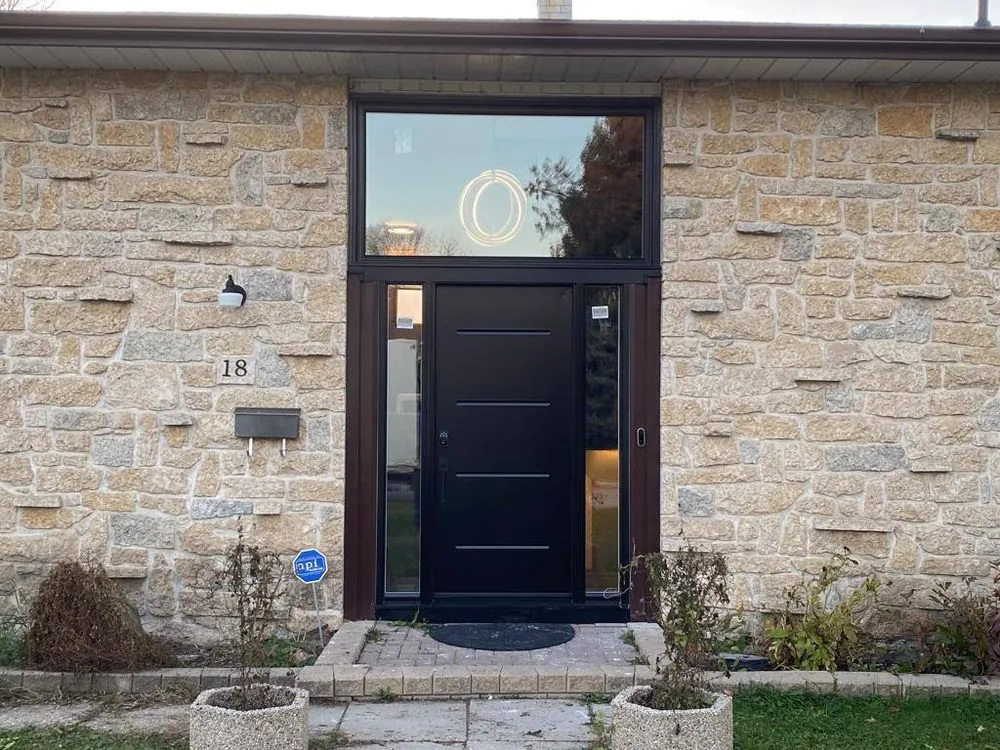
Steel vs fiberglass entry doors: both are insulated, both can be ENERGY STAR certified, and both are a big step up from an old wood door that warps, sticks and lets in drafts. The difference is in how they look, how they wear and what they cost. Here’s how each one is built, how it handles a Winnipeg winter, and how to choose.
The short answer
- Steel is strong and secure, and usually the best value for the money. It takes paint well, but a hard knock can dent it.
- Fiberglass usually costs more. It won’t dent or rust, and it can have a woodgrain texture that takes a stain, so it can look like real wood with less upkeep.
For keeping the cold out, the two are close. The frame, the weatherstripping, the glass and the install matter more than the material of the door itself.
How they’re built
Under the surface, steel and fiberglass doors are built the same way: two thin outer skins with a thick layer of insulating foam between them, held together by solid edges.
- The skins. On a steel door, these are sheets of galvanized steel. In Novatech’s steel doors they are about half a millimetre to 0.7 mm thick (Novatech specification). On a fiberglass door, they are moulded fiberglass composite, smooth or with a woodgrain texture.
- The foam core. Polyurethane foam fills the inside. This is what does the insulating, in both kinds of door.
- The edges. Wood or composite edges join the two skins. They hold the hinges and the lock, and they keep the outside skin from touching the inside skin, so cold can’t travel straight through.
- The weatherstripping. The door closes against a compression seal in the frame. On our doors it is Q-Lon weatherstripping, with an adjustable sweep at the bottom.
- The frame. The jamb the door hangs in, with the sill at the bottom. A new door comes already hung in its own frame.
- The seal to the house. The gap between the frame and the wall is insulated and sealed. Skip this, and cold air comes in around even the best door.
A standard entry door is 1¾ inches thick. ENERGY STAR Canada’s maximum U-factor for doors is 1.22 W/m²·K (Natural Resources Canada). The lower the U-factor, the less heat gets through. Ask for the rating of the exact door and glass you choose.
Steel and fiberglass side by side
| Steel door | Fiberglass door | |
|---|---|---|
| Insulation | Foam core; very good | Foam core; very good |
| Dents | Can dent from a hard knock | Doesn’t dent; a very hard blow can crack or chip it |
| Rust | Galvanized, but bare steel can rust if a scratch isn’t touched up | Can’t rust |
| Look | Smooth or panelled, painted | Smooth or woodgrain; painted or stained |
| Upkeep | Wash it; touch up deep scratches | Wash it; a stained finish needs a fresh clear coat every few years in strong sun |
| Security | Very good; depends on the frame and lock | Very good; depends on the frame and lock |
| Price | Lower | Higher |
How each handles a Winnipeg winter
Because both doors have the same kind of foam core, the slab itself is rarely the cold spot. When an entry feels cold in January, the cause is almost always one of these:
- Worn weatherstripping or sweep. If you can see daylight around the edges or under the door, cold air is getting in there.
- An old frame and sill. A frame that has shifted or rotted lets the door sit crooked, so the seals don’t touch all the way around.
- The gap behind the trim. Old doors were often installed with little or no insulation between the frame and the wall.
- Glass. Glass insulates less than the foam core, so a door with a big glass insert loses more heat than a solid one.
That is why we replace the door and frame together as one unit, with a self-draining sill, compression weatherstripping and an adjustable sweep, and insulate and seal the gap around it. A great slab hung in an old, drafty frame still lets the cold in. Read more in can you install a door without a frame?
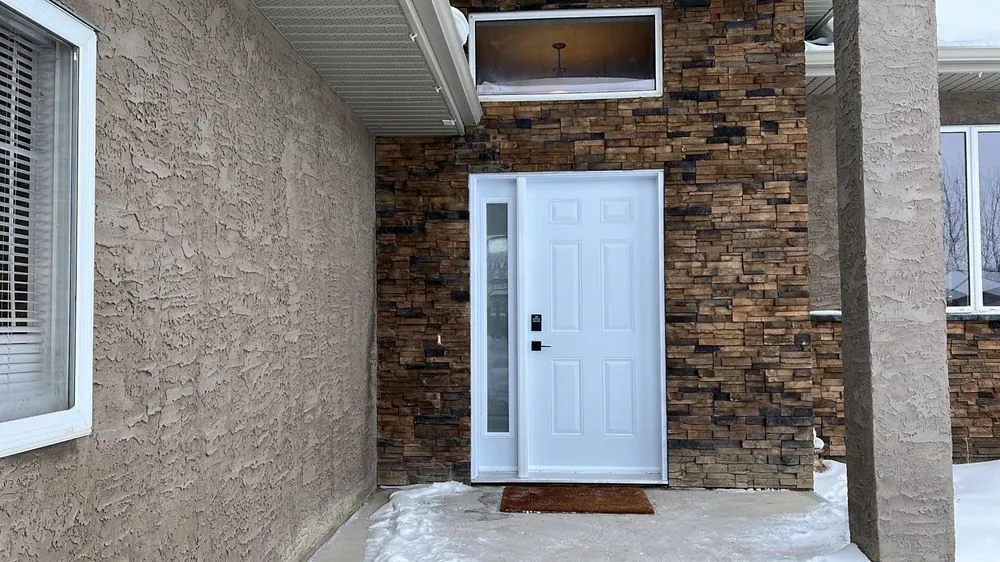
Frost on the inside of a door
Frost on the inside of a door, or on the trim around it, happens with both steel and fiberglass. It has two causes, and they often work together.
- Cold air leaking in. Wind can blow under the sill and into the uninsulated gap behind the trim, where moisture in the house air freezes. Home expert Jon Eakes traced one homeowner’s frost on new door trim to exactly this (Jon Eakes). The fix is to insulate and seal under the sill and behind the trim. Use low-expansion foam, a little at a time: too much can lift the sill and jam the door.
- High indoor humidity. The edges of a door are colder than the middle, so in very cold weather, moist air condenses or frosts there first, just as it does on windows. Keep the humidity down as the temperature drops: see the right indoor humidity for each outdoor temperature. Novatech’s steel door warranty, for example, doesn’t cover damage from condensation caused by high indoor humidity.
If frost forms on the inside handle or lock, lower the humidity first.
Dents, scratches and upkeep
- Steel. Wash it with mild soap and water. A small dent can be filled, sanded and painted. Touch up deep scratches with paint so the steel underneath stays protected.
- Fiberglass. Wash it the same way. It won’t dent, but a very hard blow can crack or chip it. A stained woodgrain finish slowly fades in strong sun and needs a fresh clear coat from time to time; a painted finish lasts like paint on steel.
- Both. Keep the weatherstripping and the sweep clean, and check each fall that they still touch the door all the way around. Don’t use abrasive cleaners or a pressure washer on the door or its seals.
Security
A steel or fiberglass slab is rarely what gives way in a break-in. When a door is forced, it is usually the frame that splits, where the lock meets the jamb. What makes a door secure:
- A solid frame, fastened to the wall framing of the house.
- A deadbolt, with long screws through the strike plate into the framing behind it.
- A security plate. We offer an optional 16-inch steel security plate at the lock.
- Strong hinges. Our doors hang on ball-bearing hinges.
Glass, sidelites and storm doors
- Glass inserts. Decorative glass lets light into the entry, and we offer more than 30 designs. For a large insert, choose triple-pane glass: glass loses more heat than the insulated door around it.
- Sidelites and transoms. Narrow glass panels beside the door, or a window above it, make a small entry feel bigger and brighter. We install and seal them together with the door.
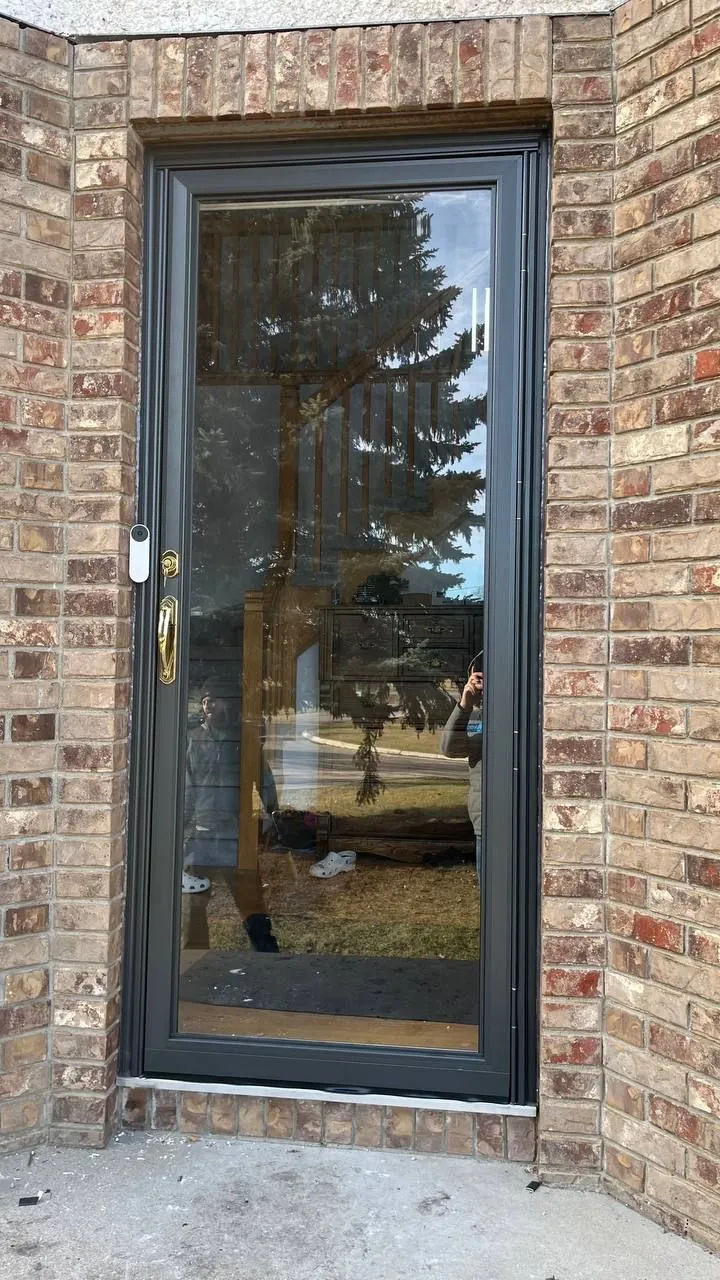
- Storm doors. A storm door adds another layer against wind and snow and protects the entry door’s finish. We install SGP StormTite storm doors. Choose one with a screen you can use in warm weather. A closed glass storm door in the sun can trap a lot of heat against the entry door. Novatech’s steel door warranty is void behind a storm door that isn’t ventilated: it needs a screen covering at least half the door’s height, and a vent panel doesn’t count (Novatech warranty).
Colours, stains and the sun
Both steel and fiberglass doors come in white or a painted colour: we offer 34 colours, and custom colours too. Fiberglass with a woodgrain texture can also be stained, for a wood look such as mahogany without the warping and peeling of a real wood door.
Dark colours absorb more of the sun’s heat. On a black or dark door that faces south or west, ask about the frames around the glass: Novatech’s PVC glass frames are rated to 65 °C and need light colours or a heat-reflective paint, while its hybrid frames, with an aluminum exterior, can take any colour.
What a new entry door costs
Here’s what a new insulated entry door costs installed, frame and all:
| Door | No glass | Small window | Half glass | Full glass |
|---|---|---|---|---|
| Entry door | $1,400 – $2,100 | $1,550 – $2,300 | $1,900 – $2,800 | $2,100 – $3,150 |
| Door + 1 sidelite | $2,400 – $3,550 | $2,550 – $3,800 | $2,900 – $4,300 | $3,100 – $4,650 |
| Door + 2 sidelites | $3,900 – $5,800 | $4,050 – $6,050 | $4,400 – $6,550 | $4,650 – $6,900 |
| Double door | $2,250 – $3,350 | $2,500 – $3,700 | $3,050 – $4,500 | $3,400 – $5,050 |
Ranges are installed prices before tax and rebates, white frames, based on Arctic Star’s own current quotes — the same numbers as our price calculator. Your exact price comes after a free in-home measure.
Fiberglass usually costs more than steel for the same style. If you’re weighing the two, ask us to price both on your quote. A storm door adds:
- Standard (white, full view or screen): $750 – $1,100
- Premium or colour (upgraded model or non-white): $950 – $1,450
Our written quotes are all-inclusive: the door and frame, installation, insulation and finishing, removal and disposal of the old door, and taxes, and rotten wood we find under the door sill is replaced at no charge. A standard door takes about three hours to install, a double door about four. For financing and rebates, ask us about the door you choose: Manitoba Hydro’s loan and Efficiency Manitoba’s rebate each have their own rules for doors, such as ENERGY STAR certification and triple-pane glass. A storm door can be financed only together with a qualifying entry door. Quoting the whole house? Ask about our volume discount. For your own door, try the price calculator.
Which should you choose?
- Choose steel if you want strength and security at the best price, and a painted door suits your home.
- Choose fiberglass if your entry takes a beating from kids, pets or deliveries, or you want a stained woodgrain look.
Either way, the door will only be as warm and as secure as its frame, seals and installation. We install steel and fiberglass entry doors made in Canada, with Novatech steel doors in styles from classic six-panel to modern flush designs. At a free in-home estimate, we measure your opening and help you compare the options. See our entry doors and door replacement.
Common questions
Is a fiberglass door warmer than a steel door?
Not by much. Both have an insulated foam core. The frame, the weatherstripping and the glass make a bigger difference to how warm the entry feels.
Will a steel door rust?
Not if the finish stays intact. The steel is galvanized, but touch up deep scratches so bare metal isn’t left exposed to moisture.
Can you replace just the door and keep the frame?
You can, but in Winnipeg we recommend replacing the door and frame together. Most drafts come from a worn frame, sill and weatherstripping, and a new door hung in an old frame rarely seals well.
Want help choosing your new front door?
Book your estimate