
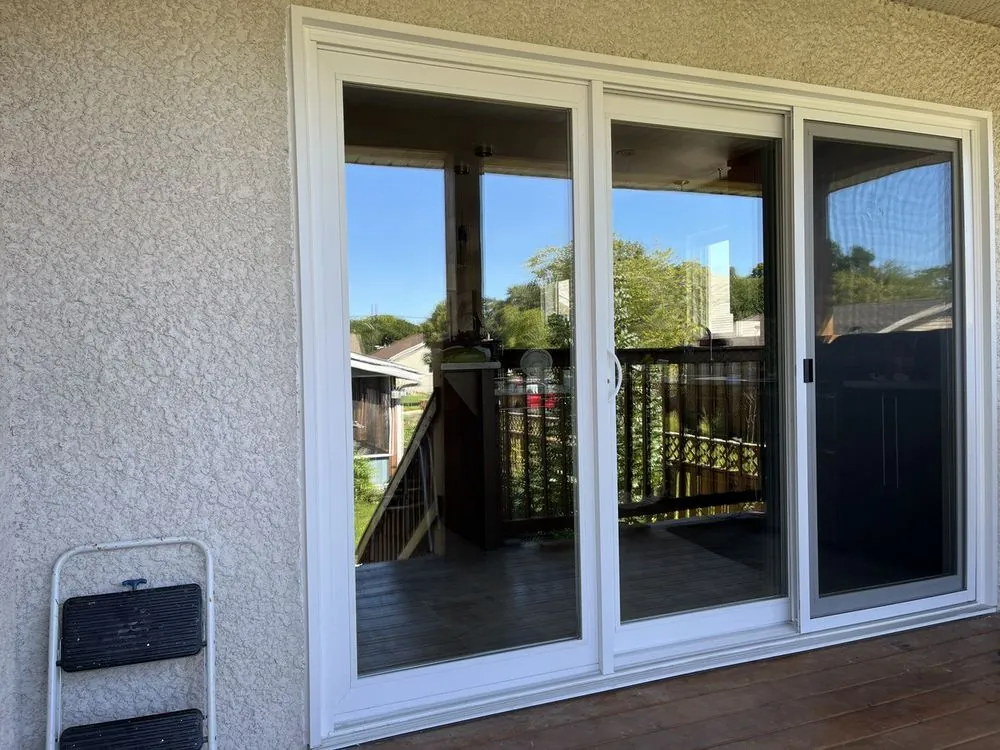
Sliding patio doors are a familiar choice in Winnipeg, but they aren’t the only one. Tilt-and-turn and stacking doors are other options, and hinged garden doors are the classic alternative. Here’s how each type opens and seals, how much room it needs, how it copes with a Manitoba winter, and what to ask before you buy.
The four types at a glance
| How it opens | Opening you can walk through | Floor space it needs | How it seals | |
|---|---|---|---|---|
| Sliding | One panel slides past a fixed one | About half (2 panels) | None | Brush or pile weatherstripping that the panel slides along |
| Tilt-and-turn | Tilts in at the top for air, or swings in like a door | All of it, when swung open | Room for the door to swing in | Compression seals the door closes against |
| Stacking (multi-slide) | Several panels slide and stack behind each other | About two-thirds (3 panels) | None, but room for the stacked panels | Sliding seals on every panel |
| Hinged (French or garden) | One or two doors swing on hinges | All of it, with both doors open | Room for each door to swing | Compression seals |
How each one works
Sliding
One or more panels roll along a track past a fixed panel. Layouts are named with X for a sliding panel and O for a fixed one, seen from outside: a 2-panel OX or XO door opens about half its width; a 3-panel OXO opens about a third, in the middle; an XOX opens a third at each end; and a 4-panel OXXO opens about half, in the middle. Nothing swings into the room or onto the deck, which is why sliders suit tight spaces.
Tilt-and-turn
A European design with one handle that does two jobs. Turn the handle to one position and the top of the door tilts into the room a few inches for secure ventilation. Turn it to another position and the whole door swings in on side hinges. It closes against compression seals, which makes it very airtight, but it needs clear floor space inside, and it usually costs more than a slider of the same size.
Stacking (multi-slide)
Three or more panels slide on parallel tracks and stack behind a fixed end panel, opening most of a wide wall in summer. Some systems slide into a pocket in the wall. More panels mean more tracks, rollers and seals to keep tight through a Winnipeg winter, and stacking doors usually cost more than sliders.
Hinged (French or garden doors)
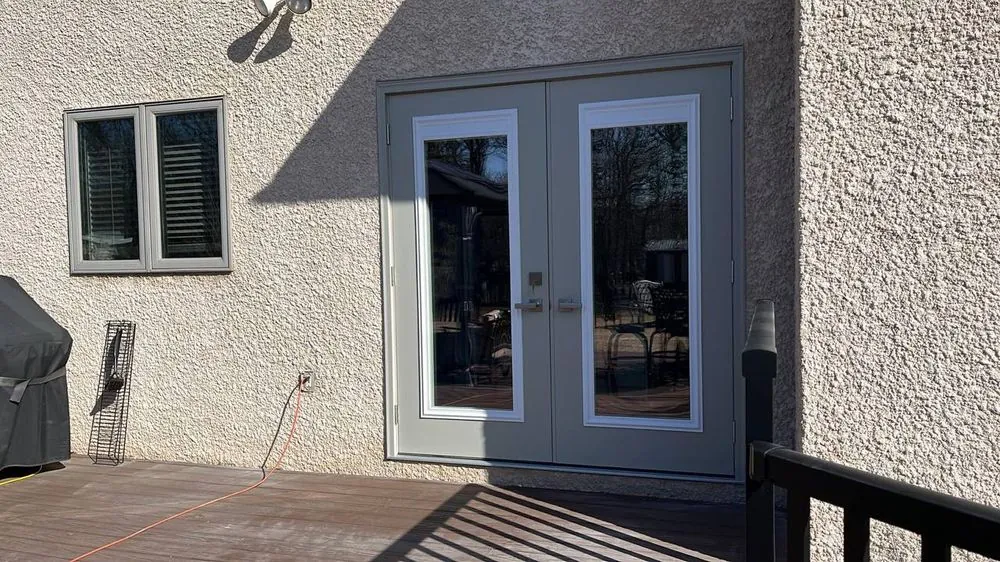
One or two doors swing open on hinges, usually inward. With both open, you get the full width. They need room for the doors to swing, inside or out: an outswing door can be blocked by a snowbank, and an inswing door needs clear floor about as wide as the door itself.
Sealing and energy
Natural Resources Canada notes that, apart from fixed windows, the most airtight windows are usually those with compression or magnetic seals, such as tilt-turn windows, while sliding windows usually use brush weatherstripping (NRCan). Patio doors follow the same pattern: tilt-and-turn and hinged doors close against compression seals, which gives them an edge for airtightness. A well-built slider still meets the same ENERGY STAR limit, though: every certified window and door, sliding or swinging, must keep air leakage to 1.5 L/s·m² or less and have a U-factor of 1.22 or lower, or an Energy Rating of 34 or higher (NRCan). A stricter standard has been proposed for 2029; it is still a draft.
The glass makes the biggest difference. Here are the three glass packages on the Novatech 550 sliding door we install:
| Novatech 550 glass | Energy Rating | U-factor |
|---|---|---|
| Double glazed, one Low-E coating (standard) | 35 | 1.65 |
| Triple glazed, one Low-E coating | 37 | 1.42 |
| Triple glazed, two Low-E coatings | 39 | 1.19 |
All three are ENERGY STAR certified, tempered and filled with argon. The two with one Low-E coating qualify through their Energy Rating (35 and 37), not their U-factor; only the door with two coatings also meets the U-factor limit. The triple-glazed options lose noticeably less heat, and triple glazing matters for money too. Efficiency Manitoba’s $100 rebate for a sliding glass door requires triple glazing (Efficiency Manitoba), and Manitoba Hydro will only finance a door with glass if it is ENERGY STAR certified and at least triple-pane (Manitoba Hydro). With either triple-glazed option, the Novatech 550 qualifies for the rebate. For what the numbers mean, see U-factor, ER and ENERGY STAR explained.
Space, steps and security
- Space. Sliders and stacking doors take no floor space to open. Tilt-and-turn and inswing hinged doors need a clear area inside about as deep as the door is wide, so plan around the dining table.
- The step. Every patio door has a raised sill to keep water out. If someone in the house uses a wheelchair or walker, ask for the sill height of each option before you choose.
- Locks. The Novatech 550 is available with a double-point lock, and with a keyed lock, a kick lock or a security bar. Tilt-and-turn and hinged doors usually lock at several points along the edge.
- Glass. All the Novatech 550’s glass packages are tempered safety glass.
Winter: frozen tracks and frost
A patio door is a big area of glass at floor level, often opening onto a deck that collects snow. The most common winter problems:
- Frost or ice on the bottom of the glass and frame. The bottom of the door is its coldest spot, and moist house air freezes there. Keep the indoor humidity down as the temperature drops, run your HRV, and don’t let heavy drapes trap air against the door. See the right humidity for each outdoor temperature.
- A frozen track or ice at the sill. Snow melts against the door on sunny days and refreezes at night. Shovel snow away from the door and the deck threshold, keep the track and its drain slots clear, and never force a frozen panel: it can damage the rollers and seals.
- A door that’s hard to lock. Seasonal movement can push sliding and hinged doors out of square (NRCan). Rollers and strike plates can be adjusted.
- An old, drafty sliding door you don’t use in winter can be sealed with removable sealant or covered with heat-shrink film until you replace it (NRCan). Never seal a door you might need to escape through in a fire, such as a patio door in a bedroom.
Looking after each type
- Sliding: vacuum the track in fall, wipe it clean, and replace worn weatherstripping and rollers when they wear.
- Tilt-and-turn: the hardware runs around the whole edge, so lubricate it once a year and have it adjusted if the door starts to drag.
- Stacking: the same as a slider, times the number of panels.
- Hinged: check the hinges, the sweep at the bottom and the weatherstripping each fall.
What a sliding patio door costs
Here’s what a Novatech 550 sliding door costs installed:
- 5 ft wide (two panels): $2,500 – $3,750
- 6 ft wide (two panels): $2,900 – $4,350
- About 12 ft wide (three or four panels): $5,400 – $8,000
Ranges are installed prices before tax and rebates, white frames, based on Arctic Star’s own current quotes — the same numbers as our price calculator. Your exact price comes after a free in-home measure.
Tilt-and-turn and stacking doors usually cost more than a slider of the same size. Replacing a door with one of the same size doesn’t need a City of Winnipeg building permit, but a new or larger opening may (City of Winnipeg). Patio doors can be paid off on your energy bill through Manitoba Hydro’s loan if they’re ENERGY STAR and triple-glazed. The home must be detached or semi-detached and your (or your tenant’s) primary residence, and Hydro must approve the loan before anything is ordered. With triple glazing, the Novatech 550 also qualifies for the Efficiency Manitoba rebate: $100 back when it replaces an existing door.
Which door suits your home?
- Choose a slider if floor space is tight, the door opens onto a busy deck, or you want the most glass for the money.
- Choose tilt-and-turn if you want the tightest seal and secure ventilation, and you have room inside for the door to swing.
- Choose stacking if you want a wide summer opening and accept the price and the upkeep.
- Choose hinged doors for a traditional look and a full-width opening, with room to swing.
For sliding patio doors, we install the Novatech 550, made in Canada: a vinyl door on a wood frame, in 2-, 3- or 4-panel layouts from 5 to 12 feet wide, with a choice of frame depths, blinds between the glass, grilles, and more than 100 colours. It is ENERGY STAR certified, rated R-PG40 under the North American Fenestration Standard with air tightness level A3, and carries a 20-year limited warranty. If another style suits your home better, we’ll tell you honestly what to look for. See our patio doors.
Common questions
Which patio door type is the most airtight?
Tilt-and-turn and hinged doors close against compression seals, which usually seal tighter than the weatherstripping a sliding panel moves along. NRCan says the same about windows. A certified slider still meets ENERGY STAR’s air-leakage limit.
Does a patio door qualify for the Efficiency Manitoba rebate?
Yes, if it is ENERGY STAR certified and triple-glazed, and it replaces an existing door in your primary residence, a detached or semi-detached house. The Novatech 550 qualifies with either triple-glazed option: $100 back. Apply within 90 days of installation and payment in full.
How do I stop my sliding door from freezing at the bottom?
Lower the indoor humidity as the temperature drops and run your HRV. Outside, keep snow away from the door and keep the track and its drain slots clear. Don’t force a frozen panel.
Do I need a permit to replace a patio door in Winnipeg?
Not for a same-size replacement. A new or larger opening may need a building permit, so check with the City of Winnipeg first.
Thinking about a new patio door?
Book your estimate