
Choosing between double-pane vs triple-pane windows comes down to climate. A triple-pane window has a third sheet of glass and a second gas-filled gap, so it loses roughly 30% less heat than a comparable double-pane window, and its inside surface stays several degrees warmer on a very cold night. It is also heavier, costs more and lets in slightly less light. On the Prairies the third pane earns its place. In mild parts of Canada and in unheated buildings, a good double-pane window is often enough.
The short answer
- Year-round home on the Prairies: triple-pane. The glass is warmer, it fogs less, and in Manitoba it is the only kind that earns the rebate or qualifies for the Hydro loan.
- Mild coastal climate, or a building you don’t heat in winter: a good double-pane window is usually enough.
- The coating matters more than the count. Going from plain double-pane glass to Low-E and argon cuts more heat loss than adding the third pane does.
- The ENERGY STAR label doesn’t settle it. Canada has one ENERGY STAR standard for the whole country, and a double-pane product can meet it.
- What we install: triple-pane windows only. Our sliding patio door comes double glazed as standard, with triple glazing as an upgrade.
Double-pane vs triple-pane windows at a glance
| Double-pane | Triple-pane | |
|---|---|---|
| Glass and gaps | 2 panes, 1 sealed gap | 3 panes, 2 sealed gaps |
| U-factor, whole window (lower is better) | About 1.5 to 1.65 W/m²·K | About 1.1 W/m²·K |
| Inside glass at −29 °C with wind | About 3 °C | About 10 °C |
| Indoor humidity before the glass fogs | About 32% | About 49% |
| Noise | Similar rating | Similar rating; slightly better on low-pitched sound |
| Glass weight | Lighter | 50% more, with panes of the same thickness |
| Daylight and sun’s heat let in | More | About 10 to 20% less |
| Price | Lower | Higher |
| ENERGY STAR Canada | Can qualify on Energy Rating; typically not on U-factor | Typically qualifies on U-factor or Energy Rating |
| Efficiency Manitoba rebate | Not eligible | $100 per opening |
| Manitoba Hydro loan | Not eligible | Eligible |
U-factor, daylight and solar heat: typical windows with Low-E glass, argon and non-metal frames, from the U.S. Department of Energy’s Building America window guide, converted to Canadian units. Glass temperature and humidity: clear glass with 21 °C indoors, from National Research Council Canada’s Canadian Building Digest 4. Noise: NRC’s Canadian Building Digest 240. Rebate and loan rules as of November 2026.
Three rows surprise people. Noise: NRC found that sealed triple glazing gives “essentially the same noise reduction as double glazing,” so don’t buy the third pane for quiet alone (see noise-reducing windows). Daylight: every layer of glass absorbs a little light, though most people never notice. And ENERGY STAR, which we explain below.
This post is the side-by-side. For how each benefit works in a cold climate, see what triple-pane windows do in a Winnipeg winter.
Heat loss: where the big steps are
The U-factor is the rate at which heat passes through the whole window, frame included. The Department of Energy guide lists typical values for each generation of window. Converted to the units on Canadian labels:
| Window | Typical U-factor (W/m²·K) |
|---|---|
| Single pane, clear glass, metal frame | About 7.3 |
| Double-pane, clear glass, non-metal frame | About 2.95 |
| Double-pane, Low-E and argon, non-metal frame | About 1.5 to 1.65 |
| Triple-pane, Low-E and argon, non-metal frame | About 1.1 |
Each step down the table is smaller than the one before. Going from a single pane in a metal frame to a clear double-pane window cuts the heat loss by more than half. Low-E coatings, argon and a better-insulated frame nearly halve it again. The third pane then takes off roughly another 30%. Natural Resources Canada describes the top end more generously: triple-glazed products are “up to 50 percent more efficient than double glazed products” (NRCan).
Two lessons follow. An old double-pane window with clear glass is much further from a new double-pane window than the names suggest. And if you are comparing quotes, a triple-pane unit with one Low-E coating can be closer to a good double-pane unit than you’d expect (the patio door table below is an example), so compare the U-factor on the label and not just the number of panes. Our guide to U-factor, ER and ENERGY STAR shows where to find it.
One ENERGY STAR standard for all of Canada
ENERGY STAR Canada uses one set of numbers for the whole country, with no separate climate zones. Under the current version, in force since January 1, 2020, a window or door qualifies with a U-factor of 1.22 W/m²·K or lower, or an Energy Rating (ER) of 34 or higher, and it must also pass an air leakage limit (NRCan).
That “or” matters when you compare double and triple glazing:
- The U-factor route looks only at heat loss. Typical double-pane windows, at 1.5 or more, don’t make it.
- The Energy Rating route also gives credit for the sun’s heat that comes in through the glass. A double-pane product that lets in plenty of sun can reach 34 even though it loses more heat at night.
Our own patio door shows it. Double glazed, the Novatech 550 has an ER of 35, which is above the minimum, with a U-factor of 1.65, which is well short of the U-factor limit.
So the blue label means the same thing in Victoria and in Winnipeg, and it does not tell you whether a window has two panes or three. On the Prairies, read the glass description and the U-factor as well.
Why Manitoba’s rebate and loan require triple-pane
Manitoba’s programs don’t leave it to the label. As of November 2026:
- Efficiency Manitoba pays $100 per eligible opening, up to $2,000 per home, and the product “must be ENERGY STAR certified and have at least triple pane glass” (Efficiency Manitoba). That applies to windows, to sliding glass doors and to entry doors with glass.
- Manitoba Hydro’s Home Energy Efficiency Loan finances up to $7,500 of windows and doors on your energy bill. Windows need triple-pane glazing, and “doors with glass must be at least triple pane” (Manitoba Hydro).
The programs don’t spell out their reasoning, but the −29 °C rows of the comparison table show why the rule fits our climate. At that temperature, the inside of clear double glazing is about 3 °C and fogs once indoor humidity passes roughly 32%. Triple glazing sits near 10 °C and holds out to about 49%. A window that is fine in a mild winter runs out of margin in ours.
In practice, a double-pane window in Manitoba gives up $100 per opening and the Hydro loan. For the steps and conditions, see our guides to the Efficiency Manitoba rebate and Manitoba Hydro financing. Whether the third pane pays for itself is a separate question: see are triple-pane windows worth it.
Where double-pane windows still make sense
Milder parts of Canada
The advantage of the third pane grows as it gets colder. On a 4 °C day, NRC’s figures put the inside of clear double glass at about 15 °C and triple at about 17 °C. That 2-degree gap is hard to feel, and neither window is close to fogging. Where winter days mostly stay above freezing, as on the south coast of British Columbia, a good double-pane window does the job, and the lighter sash and lower price count for more.
Sheds, garages and summer cottages
If a building isn’t heated in winter, there is no heat to keep in and no warm, humid air to condense on the glass. A detached garage, a shed, a three-season room or a cottage that is closed up from fall to spring is fine with double-pane windows. Seasonal properties and outbuildings don’t qualify for the Manitoba rebate in any case. We install only triple-pane windows, so for a shed window a building-supply store is the better place to look.
Some patio doors
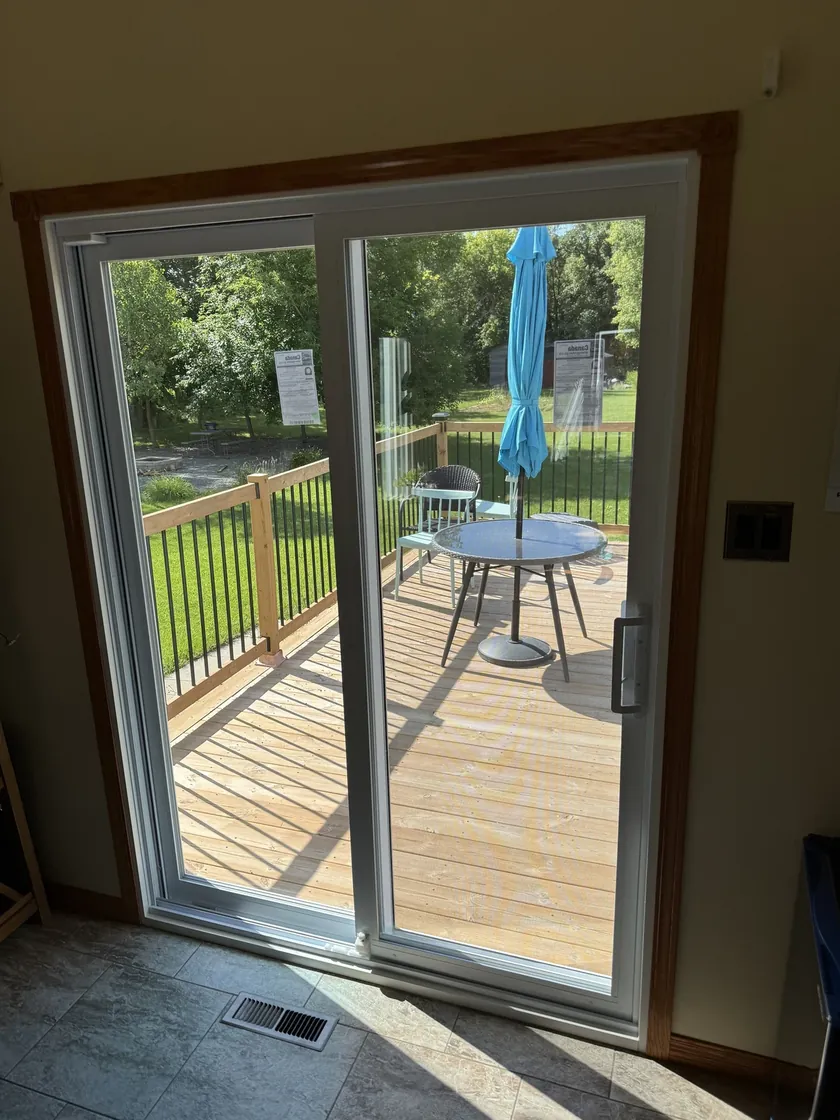
Our sliding patio door is where the choice comes up. The Novatech 550, made in Canada, comes with tempered Low-E glass and argon in three glass packages:
| Novatech 550 glass | Energy Rating | U-factor (W/m²·K) | Efficiency Manitoba rebate |
|---|---|---|---|
| Double glazed (standard) | 35 | 1.65 | No |
| Triple glazed | 37 | 1.42 | Yes |
| Triple glazed, two Low-E coatings | 39 | 1.19 | Yes |
Double glazing is reasonable for a door on a summer cottage. In a year-round Manitoba home, the patio door is often the largest piece of glass in the house and the one you sit closest to, and only the triple-glazed versions earn the rebate or qualify for the Hydro loan. See our patio doors and patio door replacement cost.
What a good double-pane window still needs
If double-pane is right for your project, the difference between a basic unit and a good one is large. Look for:
- A Low-E coating. Plain clear glass belongs in a shed.
- Argon in the gap in place of air.
- A warm-edge spacer instead of bare aluminum, to keep the edge of the glass warmer, where condensation starts.
- A non-metal frame, such as vinyl with several hollow chambers. See PVC vs vinyl windows.
- A tight seal and a careful install. Hinged windows such as casements and awnings are more airtight than sliders (NRCan), and the gap between the frame and the wall has to be insulated and sealed.
- ENERGY STAR certification, checked against the model number.
What each of these does, and how to check for it on a quote, is in Low-E glass and argon explained. The same list applies to triple-pane windows: three panes of clear glass around an aluminum spacer are not a good window either.
How to choose
- A home in Manitoba that you heat all winter: triple-pane windows, with Low-E and argon. You get the warmer glass and the rebate.
- A patio door in that home: triple glazed, for the same reasons.
- A mild-climate home: a good double-pane window is a sound choice.
- An unheated or summer-only building: double-pane.
- Everywhere: compare the U-factor and the Energy Rating on the label, and ask who installs the window and how the gap around it is sealed. Our guide to choosing replacement windows covers the rest.
Every window we install is triple-pane with Low-E glass and argon, ENERGY STAR certified and made in Canada. For a sense of price, a medium casement (about 30″ × 48″) is $850 – $1,300 installed.
Ranges are installed prices before tax and rebates, white frames, based on Arctic Star’s own current quotes — the same numbers as our price calculator. Your exact price comes after a free in-home measure.
Common questions
Is triple-pane really better than double-pane?
In a cold climate, yes. A comparable triple-pane window loses roughly 30% less heat, and on a windy −29 °C night the inside surface of the glass is about 7 degrees warmer, so it is more comfortable to sit beside and fogs far less. In a mild climate the gap is small and a good double-pane window is often enough.
How much more efficient are triple-pane windows than double-pane?
Natural Resources Canada says triple-glazed products are up to 50% more efficient than double-glazed ones. For typical whole windows with Low-E glass, argon and non-metal frames, U-factors run about 1.1 W/m²·K for triple-pane and 1.5 to 1.65 for double-pane, a difference of roughly 30%.
Can a double-pane window be ENERGY STAR certified in Canada?
It can meet the standard. ENERGY STAR Canada has one set of criteria for the whole country: a U-factor of 1.22 W/m²·K or lower, or an Energy Rating of 34 or higher. Typical double-pane windows miss the U-factor limit, but some reach the Energy Rating because it also counts the sun’s heat.
Do double-pane windows qualify for the Efficiency Manitoba rebate?
No. As of November 2026, Efficiency Manitoba’s $100-per-opening rebate requires products that are ENERGY STAR certified and at least triple-pane. Manitoba Hydro’s Home Energy Efficiency Loan has the same triple-pane requirement.
Are triple-pane windows much heavier than double-pane?
The glass is 50% heavier when all the panes are the same thickness. Frames and hardware made for triple-pane glass are built for that load, so you won’t notice it in daily use, but it limits how large an opening sash can be and adds to the load on a bay or bow window.
Is double-pane good enough for a garage, shed or cottage?
Yes, if the building isn’t heated through the winter. There is no heat to save and little indoor humidity to condense on the glass. For a cottage or garage that you heat all winter, treat it like a house and choose triple-pane.
Does Arctic Star install double-pane windows?
No. Every window we install is triple-pane vinyl with Low-E glass and argon. Our Novatech 550 sliding patio door is different: it comes double glazed as standard, with triple glazing as an upgrade.
Deciding on glass for your home?
Book a free in-home estimate and we’ll measure, quote and explain which products qualify for the rebate. For a quick ballpark first, try the price calculator, or visit our showroom at 854 Marion Street, Unit 9, in Winnipeg.
Not sure which glass your home needs?
Book your estimate